
Bachelors / Masters Projects
Master’s Project in Experimental Condensed Matter Physics
Two-dimensional Josephson Arrays
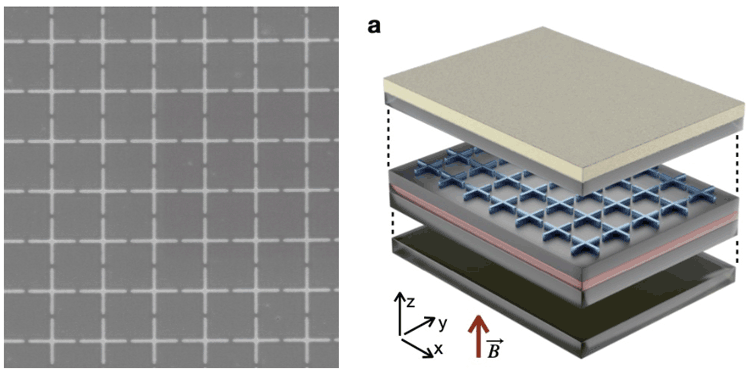
Josephson arrays can be fabricated from superconductor-semiconductor heterostructures, allowing voltage control of phase transitions. What new phases of matter will emerge when a flux is thread and the gate voltage is changed? Can we generate unique ground states in different lattice geometries? Read more here >>
To learn more, contact Charles Marcus or Saulius Vaitiekénas.
Bachelors and Masters Student Projects
Experiments on quantum wires and hybrid quantum dots
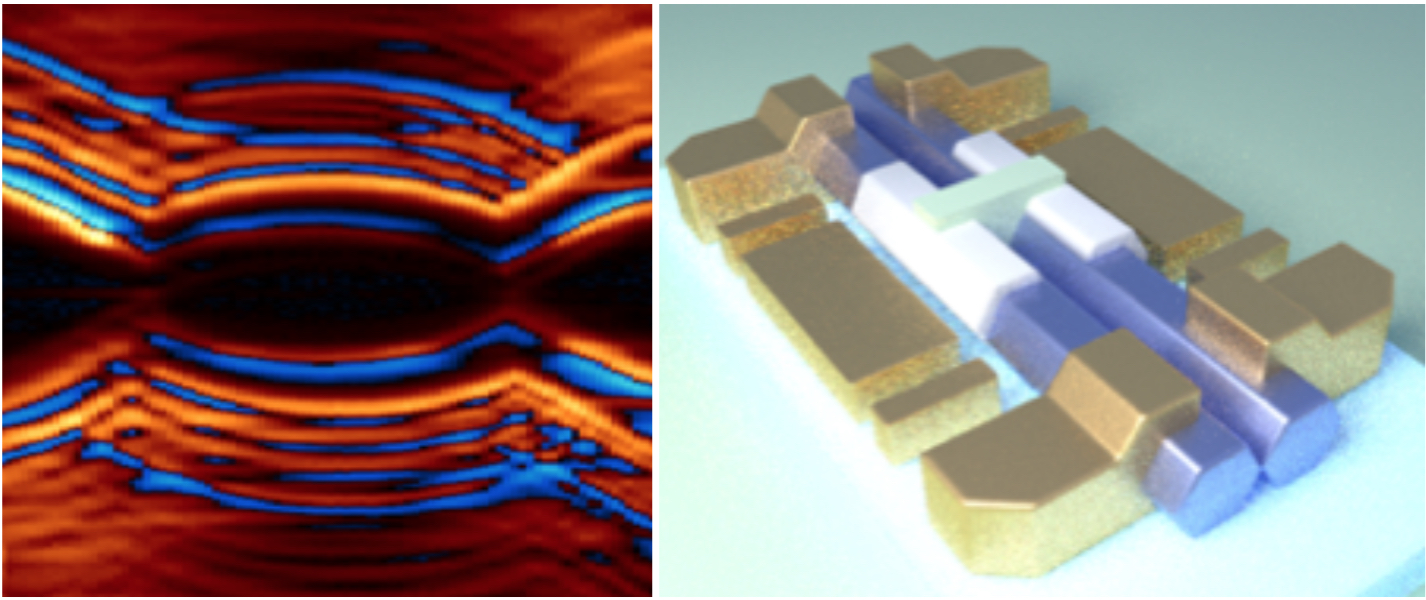
Student projects will focus on devices based on nanostructured materials synthesized in-house such as semiconductor nanowires or carbon-based materials. When superconducting electrodes are attached to such wires, they form quantum dots where we can study the states arising in such ”artificial superconducting atoms/molecules”.
Currently we are investigating these quantum states and the coupling between them in different multi-quantum-dot geometries consisting of, e.g., serial or parallel double quantum dots contacted with one or more superconducting electrodes. Read more here >>
 If you are interested in being involved please contact Jesper Nygård.
Bachelors and Masters Student Projects
Ferromagnetic hybrid nanowire development for quantum devices
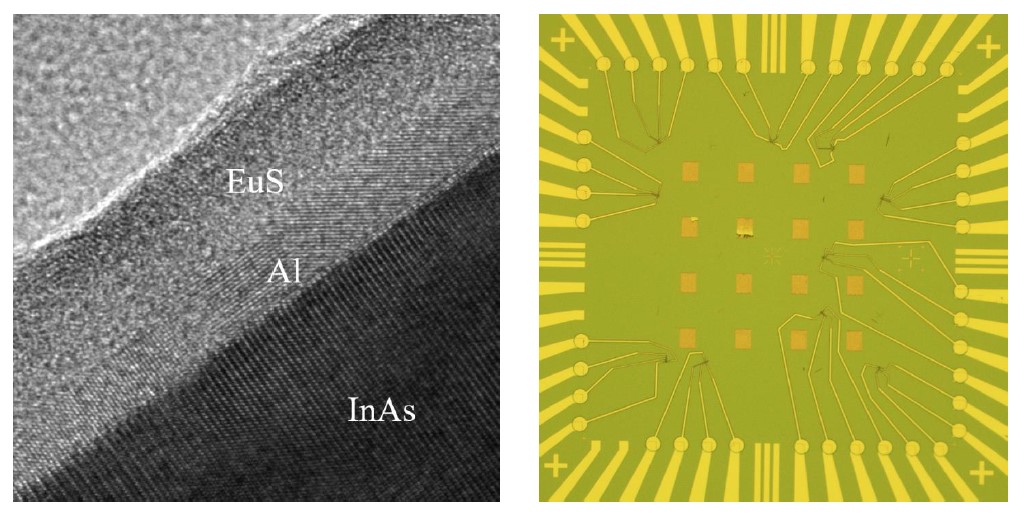
Ferromagnetic hybrid nanowires provide possibilities to extend the current research of semiconductor-superconductor hybrid nanowires. The student projects will focus on devices based on in-house synthesized semiconductor-superconductor-ferromagnetic insulator hybrid nanowires. Read more...
If you are interested, do not hesitate to contact supervisors, Yu Liu or Jesper Nygård.
Masters project in QDev
Artificial molecules hosted by cross-sectioned crystal fibers
A new Masters project focusing on the experimental investigation of arrays of artificial atoms is available in the Center for Quantum Devices (QDev). You will learn a unique approach to slicing nano-scale crystals and apply this knowledge to build electronic quantum devices in a new way (patent pending).
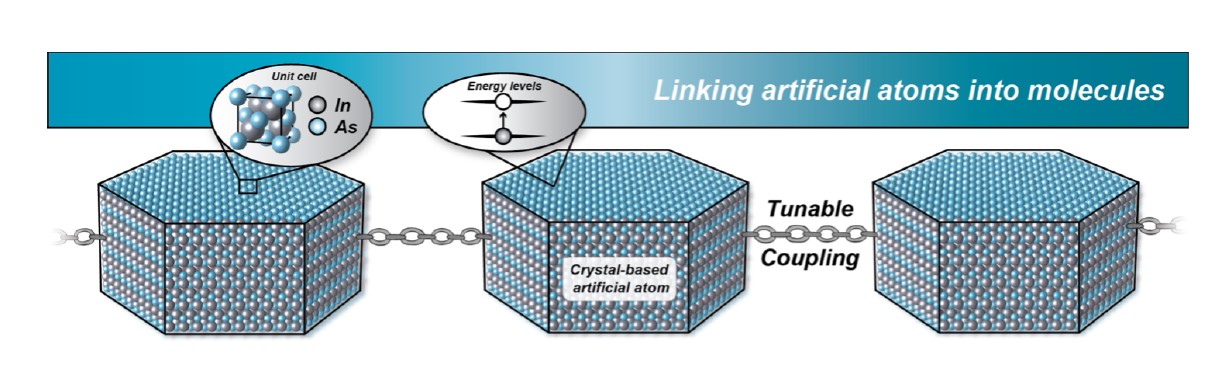
These devices will be measured at sub-kelvin temperatures where you will investigate how this new technique can be used to tune the coupling between artificial
atoms/quantum dots in arrays. Read more...
If this sounds interesting contact Jesper Nygård or Joachim Sestoft.
Masters project in QDev
Insect brain-inspired nanophotonics for nanoscaled AI
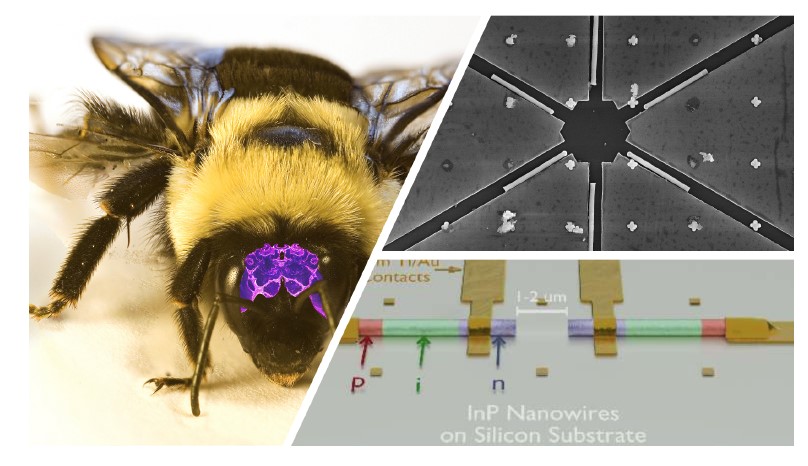 In this project you will become part of a European team (www.insectneuronano.lu.se) composed of neuroscientists, roboticists, chemists and physicists – all in the endeaver to achieve nanoscaled neuromorphic computing with low energy consumption.
Together with collaborators, your main focus will be to explore nanophotonic circuitry for nanowire-to-nanowire communication and nanowire-based memory components. Read more...
If this sounds interesting contact Jesper Nygård or Joachim Sestoft.
Masters project in QDev
Crystal structure defined quantum dots
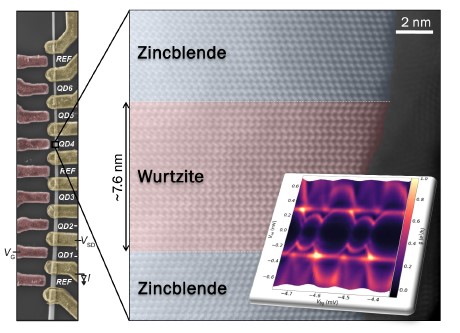
In this project you will build and measure nanowire-based quantum devices at sub-kelvin temperatures to investigate how different crystal phases (wurtzite/zincblende) create potential wells which can trap single electronic states. In these devices you will discover, for instance, how two of these states interact or how they couple to superconductors. Read more...
If this sounds interesting contact Jesper Nygård or Joachim Sestoft.
Atomic structures of exotic nanomaterials
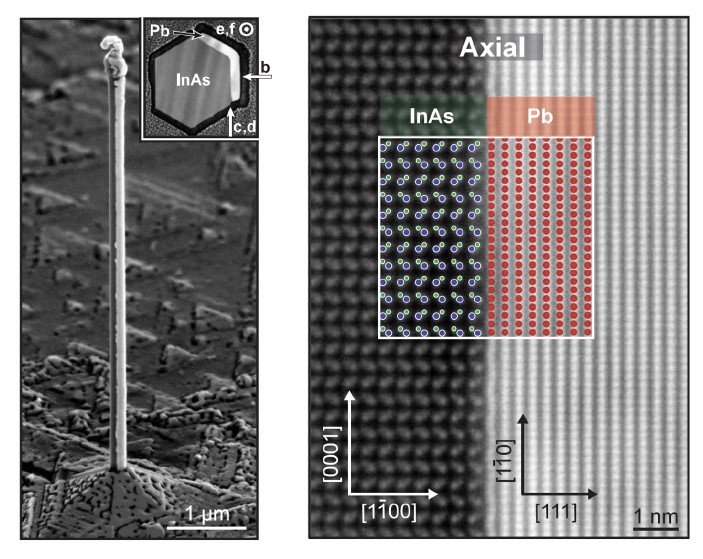
In this project you will learn to operate our state-of-the-art transmission electron microscope (among other) to study composition, morphology, epitaxy and crystal structures of novel nano-scale semiconductors. Using this knowledge you will become an integral part of the materials research team investigating exotic materials who are all key components in emerging quantum applications.
If this sounds interesting contact Jesper Nygård or Martin Bjergfelt.
Master’s Project in Experimental Condensed Matter Physics
Enter Altermagnetism: a new state of matter
A new Master’s Project is available in the Quantum Matter Lab, Center for Quantum Devices, to explore altermagnetism — a newly discovered type of magnetic material that behaves in a way unlike anything seen before. These materials combine features of ferromagnets and antiferromagnets, offering entirely new ways to control electron spins and create unusual quantum effects.
In this project, you will design, fabricate, and measure superconducting devices that use altermagnetic materials as a key ingredient. By sending tiny currents through these devices at ultralow temperatures, we aim to uncover how altermagnets interact with superconductivity and whether they can create completely new quantum states of matter. Read more about the new field of altermagnetism here: https://arxiv.org/abs/2204.10844.
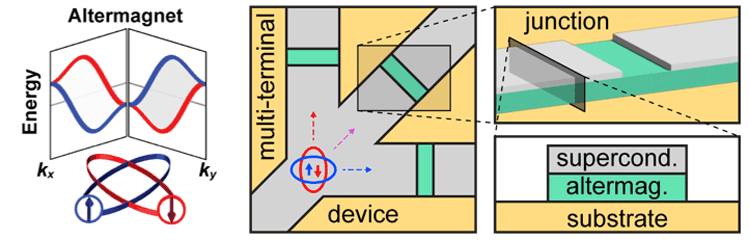 You will learn the physics of superconductors, magnetism, spin transport, and quantum devices, as well as practical skills in nanofabrication and low-temperature measurements. You will work closely with PhD students, postdocs, and faculty, using some of the most advanced equipment in condensed matter physics.
If you are interested, contact Saulius (Sole) Vaitiekėnas (saulius@nbi.ku.dk) and Lucas Casparis (lucas.casparis@nbi.ku.dk).
Master’s Project in Experimental Condensed Matter Physics
Superconductors and ferromagnets: fight or compromise?
A new Master’s Project is available in the Quantum Matter Lab, Center for Quantum Devices, to experimentally investigate the interaction of superconductors with ferromagnetic insulators as a route to producing spin-triplet superconductors.
When simple metals become superconductors at low temperatures, electrons in the metal pair up with opposite spins, resulting in a total electron spin zero in the material. A ferromagnetic insulator grown on the surface of the metal favors spin alignment. Who wins, the superconductor or the ferromagnet?
Under the right circumstances, it is predicted that the two opposing trends can find a compromise and form a new kind of superconducting state of electron pairs with aligned spins. Is it true? It’s not known.
This project is to build devices based on nanowires that encourage the aligned-spin-superconductor state to form and to detect it, if it’s there. Read more about the experiment here: https://arxiv.org/abs/2004.02226 & https://arxiv.org/abs/2508.12056.
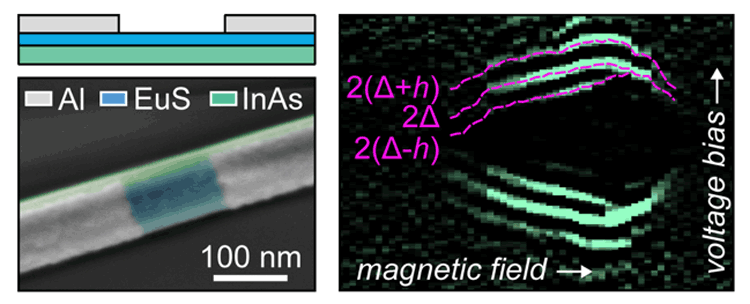
The project involves nanofabrication and low-temperature measurement in collaboration with PhD students, postdocs, and faculty. You will learn the physics of semiconductors, superconductors, ferromagnetic insulators, low-temperature measurement, triplet superconductivity, and the Josephson effect. Work with the best equipment in condensed matter physics on a problem that the world cares about. Discuss physics with colleagues and become an experimental scientist.
If you are interested, contact Saulius (Sole) Vaitiekėnas (saulius@nbi.ku.dk).
Master’s Project in Experimental Condensed Matter Physics
Topological full-shell nanowires
A new Master’s Project to make a topological qubit based on a full-shell semiconductor nanowire is available in the Quantum Matter Lab, Center for Quantum Devices.
The full-shell nanowire can be thought of as a superconducting vortex trapped in a wire. You can read more here: https://arxiv.org/abs/2003.13177. In brief, in the presence of spin-orbit coupling, this system can exhibit signatures of a topological phase and other new states of matter. The project involves design, fabrication, and measurement of these structures at millikelvin temperatures in collaboration with PhD students, postdocs, and faculty.
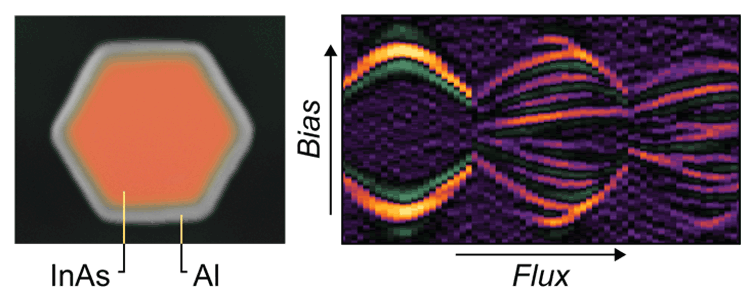
You will learn the physics of semiconductors, superconductors, nanowires, nanofabrication, topological states. Work with the best equipment in condensed matter physics on a problem that the world cares about. Discuss physics with colleagues, and become an experimental scientist.
To learn more, contact Saulius (Sole) Vaitiekėnas (saulius@nbi.ku.dk).
Master’s Project in Experimental Condensed Matter Physics
Josephson Synthesizer: Designing quantum circuits
A new Master’s Project is available in the Quantum Matter Lab, Center for Quantum Devices, to develop a Josephson synthesizer — a superconducting circuit that can shape the current–phase relation in entirely new ways. By using many hybrid Josephson elements called rhombi connected in parallel, we aim to create programmable superconducting devices with properties that cannot be achieved in conventional circuits.
This approach opens possibilities for superconducting diodes (one-way supercurrents), parity-protected qubits, and the exploration of synthetic quantum phases. The project combines nanofabrication, low-temperature measurements, and hands-on work with state-of-the-art superconducting circuits, giving you the opportunity to help build devices that could redefine the way quantum information is processed.
Read about a related experiment here: https://arxiv.org/abs/2406.20082.
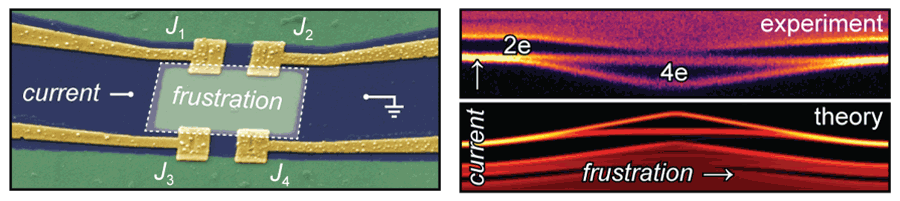
The project involves design, fabrication, and measurement of these structures at millikelvin temperatures in collaboration with PhD students, postdocs, and faculty. You will learn the physics of semiconductors, superconductors, quantum phase transitions, flat bands, and artificial lattices. Work with the best equipment in condensed matter physics on a problem that the world cares about. Discuss physics with colleagues and become an experimental scientist.
To learn more, contact Saulius (Sole) Vaitiekėnas (saulius@nbi.ku.dk).
Master’s Project in Experimental Condensed Matter Physics
Phase Slip Junctions: A New Frontier in Superconducting Quantum Circuits
A new Master’s Project is available at the Center for Quantum Devices to explore the development of phase slip junctions (PSJ) — a novel superconducting circuit element that acts as the dual to the well-known Josephson junction (JJ). Like the JJ, PSJ introduce non-linearity into quantum circuits and have shown coherent behavior (Nature 2012, arXiv:2502.07043), making them promising candidates for integration into quantum technologies. This opens exciting possibilities for engineering new types of qubits and exploring the fundamental physics of superconducting materials.
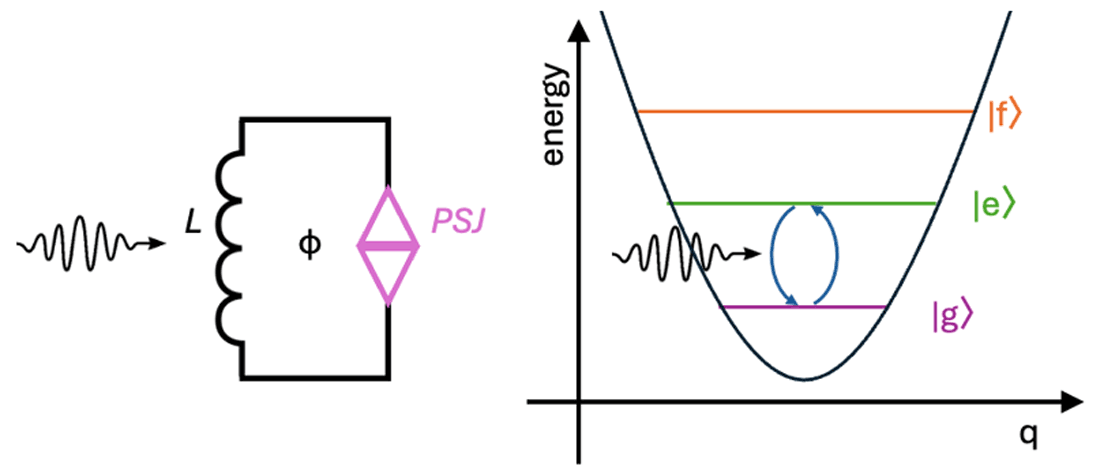
In this project, you will design, fabricate, and measure superconducting devices incorporating phase slip junctions. These devices will be studied at ultralow temperatures to investigate their quantum properties, potential applications in non-linear quantum circuits and explore new exotic materials.
You will gain expertise in superconductivity and quantum circuit design, nanofabrication and cryogenic qubit measurements. You will work closely with PhD students, postdocs, and faculty, using cutting-edge equipment and techniques in one of the world’s leading condensed matter physics labs.
If you are interested, contact: Anders Kringhøj (anders.kringhoj@nbi.ku.dk) or Lucas Casparis (lucas.casparis@nbi.ku.dk)